Description
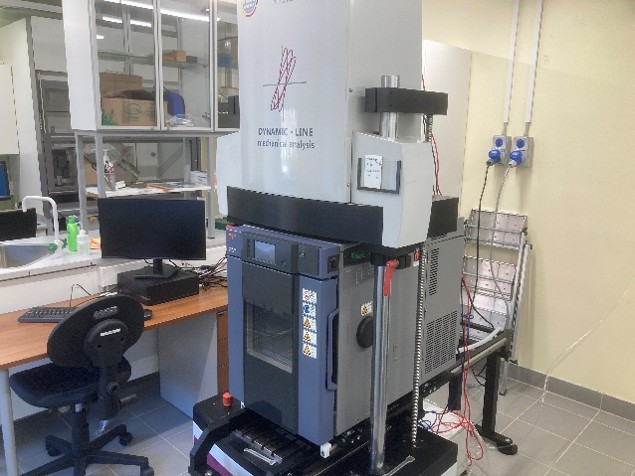
Dynamic mechanical analysis (DMA) is a method for investigating viscoelastic properties of solid materials by applying a periodically varying, usually sinusoidal load and measuring the resulting deformation and its phase shift relative to the load. These measurements yield the storage modulus, which characterizes elastic stiffness and energy storage, and the loss modulus, which characterizes energy dissipation as heat. By varying the temperature or loading frequency, DMA reveals changes in stiffness and damping behavior and can identify transitions such as the glass transition in polymers. The following tests can be performed by the device: constant stress/strain; application of stress/strain at constant rate; application of dynamic stress/strain at constant frequency; application of dynamic stress/strain at constant amplitude; creep test; stress relaxation test; fatigue test; time-temperature scans, determination of glass transition temperature.
Technical parameters |
|
| Parameter | Value and unit |
| Minimum Force | 0.0001 kN |
| Maximum Staic Force | 0.7 kN |
| Maximum Dynamic Force | 1.0 kN |
| Frequency Range | 0.001 Hz to 100Hz |
| Maximum Stroke Length | 88 mm |
| Displacement Resolution | 0.001 mm |
| Temp. range | -60 to +180°C |
| Max heating rate | 3.2°C/min |
| Max cooling rate | 2.1°C/min |
| Test Space Size without temperature cabinet (W x D x H) | 300 x 300 x 300 mm |
| Test space in the temperature cabinet (W x D x H) | 300 x 300 x 250 mm |
Testing services include:
- ISO 6721-11:2019 Plastics Determination of dynamic mechanical properties — Part 11: Glass transition temperature
- ASTM E1640-23 Standard Test Method for Assignment of the Glass Transition Temperature By Dynamic Mechanical Analysis
- ISO 6721-5:2019 – Plastics — Determination of dynamic mechanical properties — Part 5: Flexural vibration — Non-resonance method
- ASTM D5023-23 Standard Test Method for Plastics: Dynamic Mechanical Properties: In Flexure (Three-Point Bending)
- ISO 6721-12:2022 – Plastics — Determination of dynamic mechanical properties — Part 12: Compressive vibration — Non-resonance method
- ASTM D5024-23 Standard Test Method for Plastics: Dynamic Mechanical Properties: In Compression
- ISO 6721-4:2019 – Plastics — Determination of dynamic mechanical properties — Part 4: Tensile vibration — Non-resonance method
- ASTM D5026-23 Standard Test Method for Plastics: Dynamic Mechanical Properties: In Tension
Specific tests or geometries not covered by the standards can be requested.
Example of price offer
Preparation of test specimens by injection moulding: €220 + VAT. Determining dynamic-mechanical properties in tension mode (by ISO 6721-4:2019 or ASTM D5026-23, 3 comparative tests) €240 + VAT.
To discuss your potential requirements, contact Andres Krumme at andres.krumme@taltech.ee, +372 5275143